

MPPT (Maximum Power Point Tracking) and PWM (Pulse Width Modulation) are two different technologies that play important roles in solar energy systems. Here are the main differences between them:
Working principle:
PWM: By controlling the on and off of the inverter circuit switching device, a series of pulses are generated to replace the sine wave or required waveform. The width of these pulses is modulated to change the magnitude and frequency of the output voltage.
MPPT: By monitoring the power generation voltage of the solar panel in real time and tracking the highest voltage and current value (VI), the system can charge the battery with maximum power output. It adjusts the input voltage to extract maximum energy from the solar panels, independent of temperature.
Conversion efficiency:
MPPT: has higher conversion efficiency, which can reach 99%, because it can dynamically adjust voltage and current to achieve maximum charging efficiency.
PWM: The conversion efficiency is usually between 50% and 75%, because it can only pull the voltage down to the same voltage as the battery, resulting in reduced charging efficiency.
Cost and suitability:
MPPT: The cost is usually higher than PWM because it requires a more complex electrical structure and higher technology maturity. But it is suitable for larger solar systems and can support more photovoltaic panels to be connected in series to improve the utilization of photovoltaic panels.
PWM: lower cost, simple structure, convenient user wiring, and relatively cheap price. It is more suitable for small off-grid systems, but the utilization of components is relatively low.
Voltage and current range:
MPPT: It can support the solar panel voltage between 12V-170V, and the battery voltage is adjustable from 12-96V, making it more adaptable.
PWM: Usually only relevant voltages can be used together. For example, a 12V system battery board can only be used with a 12V controller and battery.
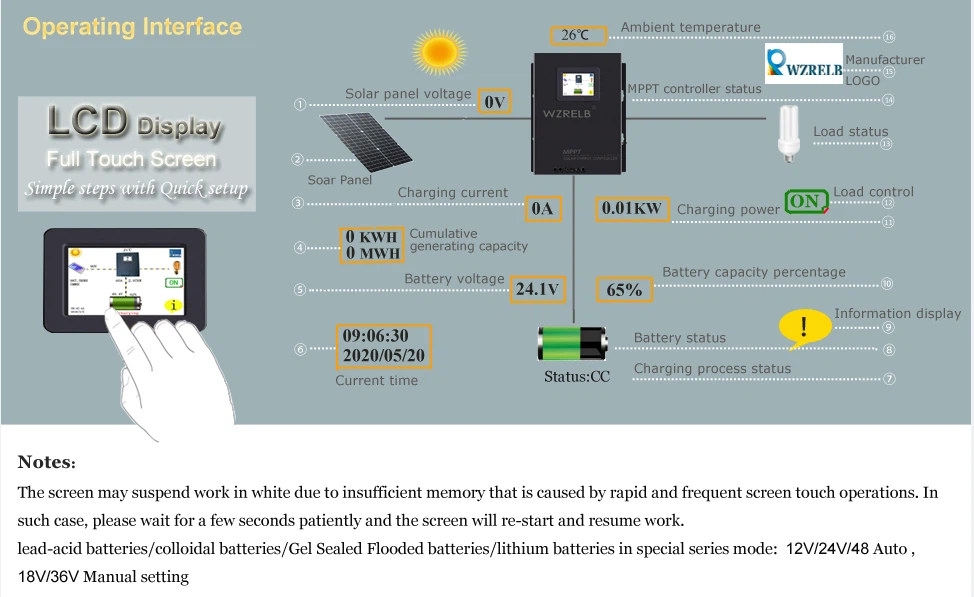
To sum up, MPPT technology provides higher conversion efficiency and greater system applicability, but the cost is also relatively high. PWM technology provides lower cost and simple circuit structure, suitable for small systems. When selecting a controller, need to consider the installation environment, cost, and system requirements.