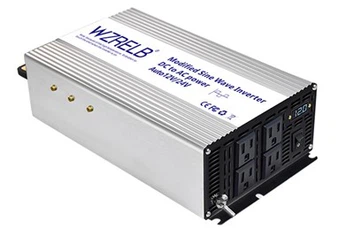
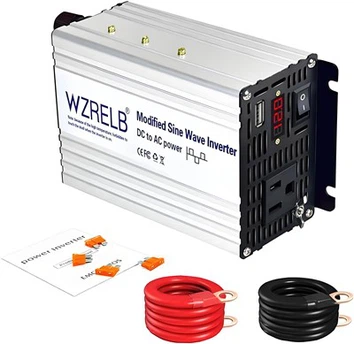
Modified Sine Wave Inverter

1


WZRELB RBX Series Modified Sine Wave Inverters

A modified sine wave inverter converts direct current (DC) from a battery into alternating current (AC) with a stepped, approximated waveform—delivering reliable, cost-effective power for the vast majority of everyday electronics, power tools, and standard household appliances. 

WZRELB's RBX Series modified sine wave inverters are available in two distinct input voltage configurations to suit every battery setup:

Single Input Voltage Models — Optimized for installations with a known, fixed battery bank voltage. Available in either 12V DC or 24V DC input.

Dual Input Voltage Models (Self-Dected) — Designed for versatility. These models feature an intelligent self-adaptive circuit that automatically detects whether the connected battery is 12V/24V or 36V/48V or 48V/60V/72V or 60V/72V/90V at startup and configures itself accordingly.


Benefits of Modified Sine Wave Inverters
 

Cost-Effective Power

Modified sine wave inverters typically cost significantly less than pure sine wave models of the same wattage, making them an ideal choice for budget-conscious users and large-scale off-grid installations.

Compatible with Most Common Loads

Standard resistive loads such as incandescent bulbs, heating elements, phone chargers, most laptops, TVs, desktop computers, and power tools all operate normally and reliably on a modified sine wave.

High Efficiency for Resistive Loads

For non-sensitive resistive devices, modified sine wave inverters deliver conversion efficiencies exceeding 90%, maximizing the usable energy from your battery bank.

Robust and Proven Technology

The stepped waveform design is a mature, well-understood technology backed by decades of field use in off-grid, RV, marine, and industrial applications worldwide.

Compact and Lightweight

The simplified power stage allows for a more compact and lightweight design compared to a full pure sine wave unit, making RBX inverters easy to install in tight spaces.

Flexible Input Voltage Options

WZRELB RBX inverters are available in two input voltage configurations—fixed single-voltage models and self-adaptive dual-voltage models that automatically detect and operate on either 12V or 24V.

Comprehensive Safety Protections

Every RBX inverter includes a full suite of built-in protections—short circuit, overload, over-voltage, under-voltage, reverse polarity, and over-temperature.

Ideal for High-Draw Tools and Appliances

The high peak surge power (up to 3× continuous rating) allows modified sine wave inverters to reliably start motor-driven loads such as power drills, circular saws, and water pumps.

Low Maintenance

With no moving parts other than the cooling fan, WZRELB RBX inverters are virtually maintenance-free and built for years of trouble-free service.


What Are the Applications of Modified Sine Wave Inverters


RV & Camper Van Power

Run your TV, laptop, phone chargers, LED lighting, and small kitchen appliances while traveling without being connected to shore power.

Work Van / Mobile Workshop

Power circular saws, drills, angle grinders, jigsaws, and other job-site tools directly from your vehicle's battery or a dedicated auxiliary battery.

Marine & Boating

Provide reliable AC power on boats for navigation electronics, fish finders, radios, LED lighting, and onboard appliances.

Off-Grid Cabins

Serve as the heart of a small solar off-grid system, converting stored battery energy into usable household AC power for lights, fans, and basic appliances.

Emergency Backup Power

Keep essential electronics running during power outages—charge phones, power LED lighting, run a small TV or radio to stay informed.

Agricultural & Outdoor Use

Power water pumps, electric fences, portable tools, and monitoring equipment in locations far from the grid.

Truckers & Long-Haul Drivers

Run microwaves, small refrigerators, CPAP machines, fans, and entertainment systems in the cab during rest periods.


How Does a Modified Sine Wave Inverter Work

DC Input
DC power from a 12V or 24V battery bank enters the inverter through the DC input terminals.

Switching Stage
High-frequency MOSFET transistors switch the DC power on and off at precise intervals, controlled by a microprocessor-based control board.

Transformer
The switched DC signal passes through a high-efficiency transformer, which steps the voltage up to the required AC output level (110V/120V or 220V/230V/240V).

Waveform Shaping
The output of the transformer produces the characteristic stepped waveform of a modified sine wave—a positive half-cycle, a brief zero-voltage pause, a negative half-cycle, and another pause—cycling at either 50Hz or 60Hz.

Output Filtering
Light output filtering smooths the edges of the stepped wave and reduces electromagnetic interference (EMI) to acceptable levels.

AC Output
The resulting modified sine wave AC power is delivered to the AC output sockets, ready to power your connected devices.

DC Input

Battery power enters through DC input terminals

Switching

MOSFET transistors switch DC at precise intervals

Transformer

Steps voltage up to AC output level

Output

Filtered AC power delivered to sockets


Maintenance Tips for Your Modified Sine Wave Inverter


Keep Ventilation Clear

Always ensure at least 20 cm (8 inches) of clearance around all sides of the inverter to allow the cooling fan to draw in fresh air and exhaust hot air freely.


Clean Regularly

Dust and debris can accumulate on the fan and ventilation grilles. Use compressed air every 3–6 months to blow out any buildup.


Inspect Battery Connections

Check the DC input cable connections at the battery and inverter terminals every 6 months. Loose or corroded connections increase resistance and reduce efficiency.


Check for Moisture

Modified sine wave inverters are not waterproof. Install in a dry location and check periodically for any signs of condensation or moisture ingress.


Monitor Operating Temperature

If the inverter's fan is running at full speed consistently during light loads, this may indicate a ventilation problem.


Follow Load Guidelines

Do not consistently operate the inverter above 80% of its rated continuous power to prevent premature component failure.


Troubleshooting Common Issues
 

Inverter won't turn on

Possible Cause: Battery voltage too low
Solution: Check battery state of charge; charge battery before use

Red LED flashing / alarm beeping

Possible Cause: Input voltage out of range
Solution: Verify DC input voltage; check cable connections and fuse

Inverter shuts off under load

Possible Cause: Overload or over-temperature
Solution: Reduce connected load; improve ventilation; check surge draw of appliances

Output voltage unstable

Possible Cause: Loose DC battery connection
Solution: Tighten all terminal connections; replace worn cables

Fan not running

Possible Cause: Fan blocked or failed
Solution: Clear obstruction; contact support if fan has failed

Device runs slowly or gets warm

Possible Cause: Load incompatibility (motor-driven or reactive load)
Solution: Check if the connected device requires a pure sine wave inverter


Single Input Voltage Modified Sine Wave Inverters

WZRELB's single input voltage RBX modified sine wave inverters are purpose-built for installations where the DC battery voltage is fixed and known in advance. 

Who Is This For?

Dedicated vehicle systems: A work van wired with a fixed 12V auxiliary battery bank, a truck with a permanent 24V chassis electrical system, or a boat with a fixed 12V or 24V service battery.

Fixed solar off-grid installations: Cabins, sheds, and remote monitoring systems where the battery bank voltage is established at the time of design and will not change.

Professional and commercial use: Applications where the inverter is permanently installed, cabled, and fused for a specific voltage.

How It Works

The single input voltage models use an advanced intelligent control chip combined with purpose-tuned hardware to convert DC power from the battery directly into a stable modified sine wave AC output. 

500 600 12


Technical Highlights — Single Input Voltage Models


DC Input Voltage

12V DC or 24V DC (specified at order)

Input Voltage Range

10–15V DC (12V) / 20–30V DC (24V)

Low Voltage Alarm

Audible + visual warning before shutdown

AC Output Waveform

Modified Sine Wave

AC Output Voltage

110V / 120V or 220V / 230V / 240V AC

AC Output Frequency

50Hz or 60Hz (specified at order)

Conversion Efficiency

≥ 90%

Status Display

LED display: DC voltage / AC voltage / load wattage


7-Point Protection System
 

Low Voltage (E1)

Input DC voltage falls below safe threshold. Inverter shuts down to protect battery from deep discharge.

High Voltage (E2)

Input DC voltage exceeds maximum threshold. Inverter shuts down immediately to protect internal components.

Over Temperature (E3)

Internal temperature exceeds safe operating limit. Inverter shuts down; restart after cooling and airflow is restored.

Overload (E4)

Output load exceeds rated continuous power. Inverter disconnects output; restart after reducing connected load.

Short Circuit (E5)

Short circuit detected on AC output. Inverter shuts down immediately; check wiring before restarting.

Reverse Polarity

Battery cables connected with reversed polarity. Internal fuse blows, protecting inverter circuit from damage.

Over Current

Output current exceeds safe limit. Inverter reduces output to protect connected devices.


4121


Auto-Detected Dual Input Voltage Modified Sine Wave Inverters

WZRELB's auto-detected dual input voltage modified sine wave inverters represent a significant step forward in installation flexibility. 

Who Is This For?

Shared and multi-vehicle use: A single inverter moved between a 12V pickup truck and a 24V commercial van.

Rental and hire equipment: Applications where the end user may not know—or may change—the battery voltage.

Installers and system integrators: Simplify your inventory by stocking one inverter model that works across both 12V and 24V deployments.

Users upgrading battery systems: If you are planning to eventually upgrade from a 12V to a 24V battery bank, an auto-detected inverter is future-proof.


How the Self-Adaptive Circuit Works

At power-up, the auto-detected inverter's microprocessor-controlled input detection circuit measures the incoming DC voltage and identifies whether the connected battery system is operating at 12V or 24V. It then automatically applies the correct:

Low voltage alarm threshold — matched to the detected system voltage

Low voltage shutdown threshold — prevents deep discharge at the correct level for 12V or 24V chemistry

High voltage shutdown threshold — protects the inverter from overvoltage at 12V or 24V levels

Power conversion parameters — the switching stage optimizes duty cycle and transformer drive for the detected input

This entire process occurs within seconds of power-up, before any AC output is delivered to connected appliances. No user intervention, no jumpers, no DIP switches, no configuration menus.

Auto-Detection

Microprocessor identifies 12V or 24V automatically

Auto-Configuration

Sets correct thresholds for voltage detected

Ready to Use

Outputs AC power within seconds


The Key Advantage: Zero Misconfiguration Risk


With a fixed single-voltage inverter, connecting a 12V-rated unit to a 24V battery—even accidentally—can damage the inverter beyond repair, and the reverse connection (24V inverter on a 12V bank) results in no output and possible confusion during installation. The auto-detected model eliminates both failure modes: it accepts both voltages safely and operates correctly at either level, making installation mistakes related to voltage selection impossible.


Key Features Across the Entire RBX Series
 

Modified Sine Wave Output

Reliable, cost-effective AC power for standard household electronics, power tools, and lighting

High Peak Surge Power

2× continuous rating to handle the startup inrush of motor-driven tools and appliances

Dual AC Output Sockets

Power two devices simultaneously without a power strip

Real-Time LED Display

Monitors DC input voltage so you always know your battery status at a glance

Intelligent Variable-Speed Cooling Fan

Whisper-quiet at light loads; ramps up automatically under heavy load to maintain safe operating temperatures

All-Aluminum Alloy Housing

Doubles as a passive heat sink for superior thermal performance and structural durability

Wide Input Voltage Range

Compatible with standard 12V and 24V lead-acid, AGM, gel, and lithium battery systems

Comprehensive 7-in-1 Protection

Short circuit, overload, over-voltage, under-voltage, reverse polarity, over-temperature, and low-voltage alarm

Extra-Thick 2.0mm PCB

Enhanced durability and improved heat spreading for long-term reliability

CE / RoHS Compliant

Meets international safety and environmental standards


Frequently Asked Questions


Q: What is the difference between a modified sine wave and a pure sine wave inverter?
A modified sine wave inverter produces a stepped, approximated waveform that is less smooth than a pure sine wave. While pure sine wave inverters are ideal for sensitive electronics and appliances with AC motors, modified sine wave inverters are significantly more cost-effective and work reliably with the vast majority of standard loads including resistive loads, TVs, computers, phone chargers, and many power tools.

Q: Can I run a microwave on a modified sine wave inverter?
Yes, microwaves are resistive loads and generally run well on modified sine wave inverters. However, you should size the inverter at 2–3× the microwave's rated wattage to account for the lower power factor of microwave magnetrons.

Q: Will a modified sine wave inverter damage my laptop?
Most modern laptops include a power brick (external power supply) that converts AC to DC internally. Since the power brick filters and regulates the input power, laptops with external power supplies are generally safe to use with modified sine wave inverters. Always verify your specific device's power requirements.

Q: How do I know what size inverter I need?
Add up the wattage of all devices you plan to run simultaneously. Choose an inverter with a continuous rating at least 20% higher than your total load. For motor-driven appliances, allow extra headroom for startup surge (typically 2–3× rated wattage).

Q: What battery cable size do I need?
Cable size depends on the inverter's wattage and the cable run length. Refer to the cable sizing guide for your specific model. Always use the recommended fuse or circuit breaker on the positive DC input line.


1


Bulk Orders & Customization

Buy bulk high-grade modified sine wave inverters direct from our factory. All customized products are available with high quality and competitive pricing.

Contact us today for a wholesale quote.

As one of the leading modified sine wave inverter manufacturers and suppliers in China, we warmly welcome you to buy bulk high-grade modified sine wave inverter from our factory. All customized products are with high quality and competitive price.