

Choosing the right off-grid pure sine wave inverter can mean the difference between a reliable power system and endless frustration. Whether you're outfitting an RV for full-time living, powering a remote cabin with solar panels, or building an emergency backup system, the pure sine wave inverter is the beating heart of your off-grid setup - and picking the wrong one can cost you time, money, and damaged equipment.
In this comprehensive guide, we'll walk you through every critical factor for selecting the best off-grid pure sine wave inverter for your specific needs - from calculating your power requirements and matching DC voltage to evaluating safety features, efficiency ratings, and brand reliability.
Why Choose a Pure Sine Wave Inverter for Off-Grid Systems?
Before diving into the selection process, it's important to understand why a pure sine wave inverter is essential for off-grid power - and how it differs from the cheaper alternative.
Pure Sine Wave vs. Modified Sine Wave Inverter: What's the Difference?
A pure sine wave inverter converts DC battery power into clean, smooth AC electricity that is virtually identical to utility grid power. A modified sine wave inverter, by contrast, produces a rough, stepped waveform that merely approximates a sine wave.
Here's why that difference matters for your off-grid system:
|
Feature |
Pure Sine Wave Inverter |
Modified Sine Wave Inverter |
|
Waveform Quality |
Smooth, continuous curve |
Stepped, blocky approximation |
|
Sensitive Electronics |
✅ Safe for all devices |
⚠️ Can damage or malfunction |
|
Motor Efficiency |
Runs cool, quiet, and efficient |
Runs hot with audible buzzing |
|
Audio/Video Quality |
Clean signal, no interference |
Hum, static, and distortion |
|
Energy Efficiency |
≥ 90% conversion |
Typically 75–85% |
|
Appliance Compatibility |
Universal - works with everything |
Limited - many devices incompatible |
Key Takeaway: For any serious off-grid solar system, RV, or emergency power setup, a pure sine wave inverter is not a luxury - it's a necessity. The price gap between pure and modified sine wave inverters has narrowed significantly, making pure sine wave the clear choice in 2026.
Step 1: Calculate Your Off-Grid Power Requirements
The most critical step in choosing an off-grid inverter is accurately sizing it to your actual power needs. An undersized inverter will overload and shut down; an oversized one wastes your budget.
How to Calculate Your Wattage
Follow these three steps:
1,List every appliance you plan to run simultaneously.
2,Record each device's wattage from its label or manual.
3,Add them up to find your total continuous power demand.
Common Off-Grid Appliance Wattage Reference
|
Appliance |
Typical Running Watts |
Startup Surge Watts |
|
LED Lights (per bulb) |
5–15W |
- |
|
Laptop Computer |
50–100W |
- |
|
CPAP Machine |
30–60W |
- |
|
LED Television |
50–150W |
- |
|
Refrigerator |
100–400W |
600–1,200W |
|
Microwave Oven |
600–1,200W |
- |
|
Coffee Maker |
600–1,000W |
- |
|
Power Drill |
500–1,000W |
1,500–2,500W |
|
Window Air Conditioner |
500–1,500W |
1,500–4,500W |
|
Well Pump |
750–2,000W |
2,000–6,000W |

Don't Forget Surge Power
Appliances with motors - refrigerators, air conditioners, pumps, and compressors - draw a startup surge of 2–3× their rated wattage for a brief moment when they turn on. Your inverter must handle these surges without tripping.
Sizing Rule of Thumb: Choose an off-grid pure sine wave inverter with a continuous power rating that's 25–30% higher than your total calculated load. Then verify its peak/surge power capacity can handle your highest-draw startup appliance.
Example: If your total continuous load is ~3,000W and your refrigerator has a 1,200W startup surge, a 4000W pure sine wave inverter with 8,000W surge capacity provides both comfortable continuous headroom and ample surge handling.
Step 2: Match the DC Input Voltage to Your Battery Bank
Every off-grid pure sine wave inverter has a DC input voltage rating that must exactly match your battery bank configuration. Using the wrong voltage will damage both the inverter and your batteries.
DC Voltage Selection Guide for Off-Grid Systems
|
DC Input |
Best For |
Why Choose This? |
|
12V |
Small RVs, single battery, portable use |
Simple, common, easy to find batteries |
|
24V |
Medium RVs, boats, small cabins |
Better efficiency for 1,500W–3,000W systems |
|
36V |
Electric vehicles, telecom, medium solar systems |
Ideal balance of efficiency and system complexity |
|
48V |
Large off-grid homes, full solar systems |
Best efficiency for 3,000W+ systems, thinner cables |
|
96V / 110V |
Commercial & industrial installations |
Maximum efficiency for heavy-duty off-grid setups |

Key Voltage Considerations
- Higher voltage systems lose less energy in cable transmission. For off-grid solar systems above 3,000W, 24V, 36V, or 48V battery banks are strongly recommended over 12V.
- Never mismatch voltages. A 12V off-grid inverter on a 24V battery bank (or vice versa) will result in immediate damage.
- Look for wide input voltage ranges. Premium off-grid inverters like the WZRELB Pure Sine Wave Inverter series support inputs from 12VDC up to 110VDC, providing unmatched flexibility to match virtually any battery configuration - from lead-acid to lithium.
Step 3: Choose the Right Power Capacity for Your Off-Grid Scenario
Not all off-grid scenarios require the same power. Here's how to match inverter capacity to your specific use case:
|
Inverter Capacity |
Ideal Off-Grid Use Case |
What You Can Power |
|
300W – 800W |
Car emergency kit, solo camping, single-device |
Phones, laptops, CPAP, LED lights |
|
1,000W – 1,500W |
Weekend camping, small RV |
TV + lights + laptop + small fan |
|
1,800W – 2,500W |
Full-time RV, small cabin |
Refrigerator + TV + lights + microwave (sequentially) |
|
3,000W – 4,000W |
Large RV, off-grid cabin, workshop |
Refrigerator + microwave + tools + multiple outlets |
|
5,000W – 10,000W |
Whole-house off-grid, commercial |
Full HVAC, workshop, all appliances simultaneously |
Pro Tip: An off-grid pure sine wave inverter running at 50–70% of its rated capacity will operate cooler, last longer, and deliver better efficiency than one constantly running near maximum load.
Step 4: Evaluate Essential Safety and Protection Features
A quality off-grid pure sine wave inverter must include comprehensive built-in protections. These safeguard both your expensive appliances and the inverter itself.
Must-Have Safety Features Checklist
✅ Over-voltage protection - Prevents damage from battery overcharging or voltage spikes
✅ Low-voltage disconnect (LVD) - Automatically shuts off before deep-discharging your batteries
✅ Overload protection - Cuts power if connected devices exceed rated wattage
✅ Short-circuit protection - Instant shutdown to prevent fires and equipment damage
✅ Over-temperature protection - Shuts down before internal components overheat
✅ Built-in soft starter - Gradually ramps up AC voltage to reduce startup surge stress, extending the lifespan of connected appliances
Cooling System Matters
Thermal management is critical for off-grid inverters, especially at higher power levels. Look for:
- Multiple active cooling fans (triple-fan systems are ideal for 3,000W+ inverters)
- Automatic speed adjustment based on load and temperature
- Aluminum alloy housing for superior passive heat dissipation
The WZRELB pure sine wave inverter lineup features triple high-efficiency cooling fans with automatic temperature regulation, combined with a corrosion-resistant aluminum alloy shell - engineered for sustained high-load operation even in extreme off-grid conditions.
Step 5: Check Conversion Efficiency - Every Percent Counts Off-Grid
In off-grid systems, inverter efficiency directly determines how far your battery charge goes. A higher efficiency rating means more of your stored solar energy reaches your devices as usable power.
|
Efficiency Rating |
What It Means |
Impact on a 200Ah 12V Battery |
|
≥ 90% |
Premium quality - industry-leading |
~2,160Wh usable AC power |
|
85% |
Average quality |
~2,040Wh usable AC power |
|
75% |
Low-end / modified sine wave |
~1,800Wh usable AC power |
That 15% efficiency difference means you'd need 20% more batteries or solar panels to compensate - a significant cost difference in any off-grid system.
What to look for: Choose an off-grid pure sine wave inverter with a clearly stated efficiency of ≥ 90%. Beware of cheap inverters that don't publish their efficiency specs - there's usually a reason.
Step 6: Verify Battery Compatibility for Your Off-Grid System
Your off-grid inverter should work seamlessly with all major battery technologies:
✅ Lead-Acid (AGM, Gel, Flooded) - Proven, affordable, widely available
✅ Lithium Iron Phosphate (LiFePO4) - Lightweight, long-lasting, ideal for solar systems
✅ Lithium-Ion - Common in portable power stations
✅ Other chemistries (NiMH, etc.)
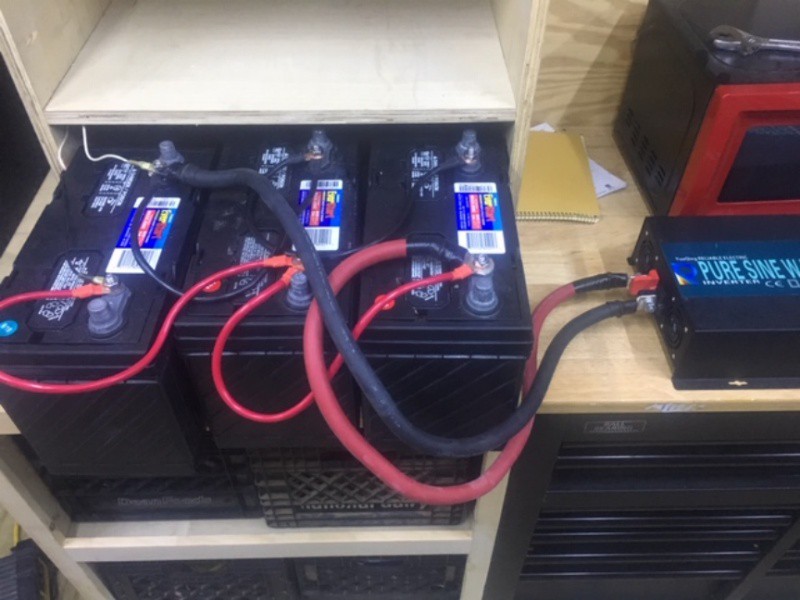
A truly versatile off-grid pure sine wave inverter requires no manual configuration changes between battery types - it simply works with whatever you connect.
Step 7: Evaluate Connectivity, Outputs, and Remote Control
Think about how you'll physically connect and control your off-grid inverter in practice:
Output Options to Look For
- Dual AC outlets (minimum) - Powers multiple devices simultaneously
- Hardwire terminal - Essential for permanent installations wired into a breaker panel
- USB ports - Convenient for charging phones, tablets, and small electronics
- Remote on/off switch - Critical when the inverter is mounted in an inaccessible location (under an RV bed, inside a cabinet, below deck on a boat)
Real-Time Power Monitoring
The ability to monitor your off-grid power system at a glance is invaluable:
- LED or LCD display showing real-time DC input voltage, AC output, and power consumption
- Fault indicator lights for overload, over-temperature, and low battery warnings
- Audible alarms for critical conditions
Knowing your battery voltage and current draw in real time lets you manage your off-grid energy reserves wisely and catch problems before they become emergencies.
Step 8: Consider Physical Size, Weight, and Build Quality
Off-grid installations - RVs, boats, remote cabins - often have limited space. Your inverter needs to fit and endure.
What to Prioritize
- Compact design - A well-engineered 4,000W off-grid pure sine wave inverter can be as small as 16 × 5.7 × 2.9 inches
- Lightweight construction - Aluminum alloy casings keep weight down (e.g., ~7 lbs for a 4,000W unit) while providing excellent thermal properties
- Rugged durability - Look for housings that resist heat, cold, humidity, vibration, and corrosion - all realities of off-grid environments
Step 9: Research Brand Reputation, Warranty, and After-Sales Support
An off-grid pure sine wave inverter is a long-term investment that you'll depend on in critical situations. Don't gamble on an unknown brand.
Brand Evaluation Criteria
|
Factor |
What to Look For |
|
Industry Experience |
10+ years specializing in power inverters |
|
Manufacturing Scale |
Dedicated production lines, ISO quality processes |
|
Global Presence |
Products tested in 50+ countries and diverse climates |
|
Customer Reviews |
Strong ratings on Amazon, solar forums, RV communities |
|
After-Sales Support |
Responsive technical team, clear warranty policy |
Off-Grid Pure Sine Wave Inverter Selection Checklist
Use this quick-reference checklist before making your final purchase decision:
- Calculated total continuous wattage (all simultaneous devices)
- Accounted for startup surge requirements (2–3× for motors)
- Chosen inverter rated 25–30% above total continuous load
- Matched DC input voltage to battery bank (12V / 24V / 36V / 48V)
- Verified all 6 essential safety protections are included
- Confirmed conversion efficiency ≥ 90%
- Checked compatibility with your battery type (lead-acid, LiFePO4, etc.)
- Evaluated output options (dual AC outlets, hardwire terminal, USB)
- Confirmed real-time monitoring display
- Assessed physical size and mounting feasibility
- Researched brand reputation and warranty terms
WZRELB: Trusted Off-Grid Pure Sine Wave Inverters Since 2009
When it comes to choosing a reliable off-grid pure sine wave inverter, the WZRELB brand by Yueqing Reliable Electric Co., Ltd. has been a proven choice worldwide for over 15 years.
Founded in 2009 with a focus on off-grid pure sine wave inverter R&D and manufacturing, WZRELB has grown into an industry leader - exporting 50,000+ inverters annually to 60+ countries across 6 continents.
WZRELB Product Range at a Glance
|
Series |
Capacity |
Surge Power |
Best For |
|
SE Compact |
300W – 800W |
2× rated |
Car kits, solo camping, charging stations |
|
Standard |
1,000W – 2,500W |
2× rated |
RVs, weekend cabins, emergency backup |
|
High-Power |
3,000W – 4,000W |
2× (up to 8,000W) |
Off-grid cabins, workshops, full-time RV |
|
Heavy-Duty |
5,000W – 10,000W |
2× rated |
Whole-house off-grid, commercial solar |
|
Split Phase |
Various |
2× rated |
North American 120V/240V homes |
Why Off-Grid Users Choose WZRELB Inverters
- ≥ 90% conversion efficiency - Maximizes every watt from your battery bank
- Ultra-wide DC input range (12V – 110VDC) - Fits any battery configuration
- Full protection suite - Over-voltage, low-voltage, overload, short-circuit, over-temperature + soft starter
- Triple-fan active cooling - Reliable operation under sustained high loads and extreme temperatures
- Medical-grade clean output - Safe for CPAP machines, nebulizers, and sensitive medical equipment
- Aluminum alloy construction - Lightweight, heat-resistant, corrosion-proof
- Real-time LED/LCD monitoring - Voltage, power consumption, and fault status at a glance
- Universal battery compatibility - Lead-acid (AGM, Gel, Flooded) and Lithium (LiFePO4) with no configuration needed
Whether you need a compact 300W car inverter or a rugged 10,000W heavy-duty off-grid pure sine wave inverter, WZRELB has a solution engineered specifically for your off-grid power needs.
Frequently Asked Questions About Off-Grid Pure Sine Wave Inverters
Is a pure sine wave inverter worth the extra cost for off-grid use?
Absolutely. The price difference between pure sine wave and modified sine wave inverters has shrunk dramatically. Meanwhile, the benefits - protection for sensitive electronics, higher efficiency (meaning smaller battery banks), universal appliance compatibility, and quieter operation - make pure sine wave the clear value choice for any off-grid system in 2025.
How do I connect an off-grid inverter to my battery bank?
Use properly sized battery cables (wire gauge depends on wattage and cable length). Connect DC positive to positive, negative to negative. For systems above 1,500W, use the hardwire terminal with appropriate fusing rather than plug-in connections. Always follow the manufacturer's installation guide.
Can I run my off-grid pure sine wave inverter continuously (24/7)?
Yes. Quality off-grid pure sine wave inverters are designed for continuous duty at their rated wattage. For maximum longevity, keep your sustained load at 50–70% of rated capacity, ensure adequate ventilation around the unit, and make sure your battery bank can sustain the output.
How many batteries do I need for my off-grid inverter?
Use this simplified formula:
Battery Capacity (Ah) = (Wattage × Hours) ÷ (Battery Voltage × Efficiency × Depth of Discharge)
Example: Running 1,000W for 4 hours on a 12V system at 90% efficiency with 50% DoD:
(1,000 × 4) ÷ (12 × 0.9 × 0.5) = 741 Ah of battery capacity needed
What's the difference between a single-phase and split-phase off-grid inverter?
- Single-phase inverters output standard 120V or 230V AC - suitable for most household devices.
- Split-phase inverters provide both 120V and 240V outputs (standard in North American residential panels), required for large appliances like well pumps, central air conditioners, and electric dryers.
If you're building a full off-grid home in North America, a split-phase pure sine wave inverter is likely essential.
What size off-grid inverter do I need for an RV?
Most full-time RV setups with a refrigerator, microwave, TV, lights, and charging stations need a 2,000W – 3,000W pure sine wave inverter. If you plan to run an air conditioner or space heater, consider 3,500W – 5,000W. Always calculate your specific loads using the wattage chart above.
Conclusion: Invest in the Right Off-Grid Pure Sine Wave Inverter
Choosing the right off-grid pure sine wave inverter comes down to five fundamentals:
- Size it correctly - Calculate your loads and add a 25–30% buffer
- Match your voltage - Align DC input with your battery bank
- Demand safety features - Accept nothing less than full protection
- Prioritize efficiency - ≥ 90% saves you money on batteries and solar panels
- Trust proven brands - 10+ years of experience matters in critical power systems
A well-chosen pure sine wave inverter is the foundation of every successful off-grid power system. It delivers clean, stable, efficient electricity that keeps your appliances safe, your batteries healthy, and your off-grid lifestyle running smoothly - for years to come.
Ready to find the perfect off-grid pure sine wave inverter for your system? Explore the complete WZRELB inverter lineup or contact us for personalized recommendations.